Why Cleaning a Minneapolis Business Is Different From Cleaning Almost Anywhere Else in Minnesota
From Downtown Skyways and North Loop Warehouses to Neighborhood Storefronts, Busy Restaurants, and Long Minnesota Winters, Minneapolis Businesses Deal With Cleaning Challenges That Change Block by Block

Minneapolis does not really have one type of business district.
Walk a few blocks downtown and you can move from a corporate office tower to a hotel, restaurant, entertainment venue, and retail space without ever going outside. Head over to the North Loop and you are dealing with historic warehouse buildings that have been turned into offices, restaurants, shops, and apartments. Drive farther into the city and you find neighborhood businesses along Lake Street, Hennepin Avenue, Nicollet Avenue, Central Avenue, West Broadway, and dozens of other commercial corridors.
Those buildings are all in Minneapolis, but they do not get dirty in the same way.
At Minneapolis Commercial Cleaning, we believe commercial cleaning works best when the plan reflects the actual building, neighborhood, traffic, and people using the space.
In a city this active, handing every business the same cleaning checklist simply does not make much sense.
Downtown Minneapolis Has Its Own Cleaning Rhythm
Downtown is probably the clearest example.
An office building may start getting busy before 8 a.m. Employees arrive, coffee shops open, deliveries start coming in, meetings begin, and people move between buildings throughout the day.
Then the workday ends and another crowd arrives.
Restaurants get busier. Sporting events and concerts bring people downtown. Hotels welcome guests. Theater traffic picks up.
A commercial property that is relatively quiet at 10 a.m. may look completely different at 7 p.m.
That means cleaning schedules should consider when a building gets busy, not just how many square feet it has.
For some downtown properties, evening service makes perfect sense.
For others, certain entrances, restrooms, common areas, and high traffic spaces may need attention before the evening cleaning crew ever arrives.
The Skyway Changes How People Move Through Buildings
Downtown Minneapolis has something most cities do not: an extensive skyway system connecting approximately 80 city blocks.
That is great when the temperature drops below zero.
It also creates some unusual cleaning patterns.
In a normal building, you might assume the street entrance gets the most traffic.
In a skyway connected property, that is not always true.
Employees may enter from a parking ramp, walk through another building, cross several skyways, and arrive on an upper floor without ever touching the main lobby.
Now suddenly the busiest entrance to your business may be on the second floor.
That matters.
The cleaning crew needs to know where people actually enter, where they walk, and which common areas get used throughout the day.
The building tells you where the cleaning should happen if you pay attention to the traffic patterns.
Minnesota Winter Still Finds a Way Inside
The skyway helps downtown.
It does not eliminate winter.
Every Minneapolis commercial property eventually deals with snow, salt, sand, moisture, and slush.
Street level businesses usually get the worst of it.
Someone walks in with wet boots.
Then another person.
Then fifty more.
Entry mats get saturated. Salt dries into that familiar white film. Sand works itself into carpeting. Wet footprints start moving farther into the building.
The challenge is not that winter makes cleaning impossible.
It just changes how often certain areas need attention.
During snowy stretches, businesses may need additional cleaning around:
- Entry mats
- Hard floors
- Carpeted entrances
- Salt residue
- Glass doors
- Door handles
- Vestibules
- High traffic walkways
Waiting several days between floor cleanings during a Minnesota snowstorm can turn a small maintenance job into a much bigger one.
The North Loop Is a Completely Different Environment
Drive a few minutes from the heart of downtown and the cleaning situation changes again.
The North Loop and Warehouse District are known for historic warehouse buildings that have been converted into restaurants, shops, offices, residences, and other commercial spaces.
Those buildings have character.
They can also have plenty of places for dust to hide.
Older commercial spaces may have exposed brick, beams, pipes, high ceilings, window ledges, detailed trim, concrete floors, and other surfaces that require a different approach from a modern office tower.
A beautifully renovated warehouse can have spotless floors and still look dusty if nobody remembers the ledges fifteen feet above them.
That is why periodic high dusting and detail cleaning become especially important in spaces like these.
Restaurants Bring Their Own Kind of Traffic
Minneapolis has restaurant activity spread throughout downtown, the North Loop, Northeast, Uptown, Eat Street, Lake Street, and neighborhood business districts across the city.
Restaurants have one advantage when it comes to cleaning.
You usually know exactly when they are going to get messy.
Lunch.
Dinner.
And everything in between.
Customer areas deal with food, drinks, footprints, trash, fingerprints, and restroom traffic throughout the day.
A restaurant may look great when the doors open and need attention only a few hours later.
That is normal.
Customer facing cleaning may involve:
- Dining area floors
- Entrances
- Restrooms
- Glass
- Tables and surrounding areas
- Waiting areas
- High touch surfaces
- Trash areas
The deeper cleaning can happen after closing, but some things simply cannot wait until the end of the night.
Minneapolis Offices Have Changed, but They Still Get Dirty
Office buildings can be deceptive.
A quiet office does not necessarily mean a clean office.
Even when fewer people are in the building on certain days, the same areas continue getting used.
People still make coffee.
Restrooms still get traffic.
Conference rooms still host meetings.
Trash still collects.
Dust definitely does not take a hybrid workday off.
The mistake is assuming that every office needs exactly the same amount of cleaning every day.
It usually does not.
If Tuesday through Thursday are the busiest days, the cleaning plan can account for that.
A good schedule should follow the way employees actually use the space now rather than the way the office operated five years ago.
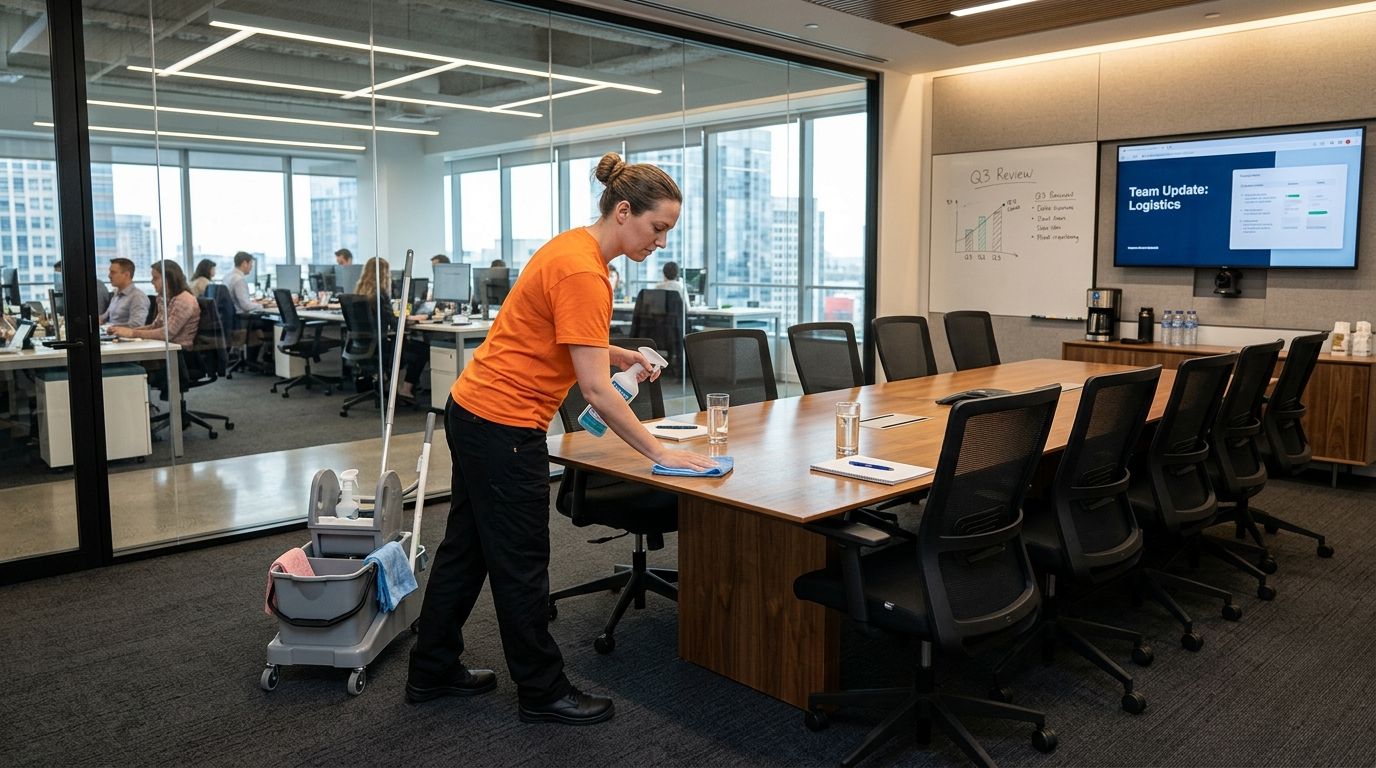
Conference Rooms Can Go From Empty to Messy in an Hour
A conference room might sit untouched all morning.
Then twelve people come in with coffee and lunch.
Chairs move.
The table gets covered with laptops, notebooks, drinks, and fingerprints.
The whiteboard gets used.
Someone drops crumbs on the floor.
An hour later, the room is empty again and looks fairly normal from the doorway.
Look closer and it is a different story.
If customers, prospective employees, or vendors regularly use your conference rooms, these spaces should be part of the regular cleaning routine even when they do not appear obviously dirty.
Neighborhood Businesses Are a Huge Part of Minneapolis
Downtown gets plenty of attention, but Minneapolis business activity stretches far beyond downtown.
The city supports commercial districts throughout its neighborhoods through programs such as Great Streets, which focuses on strengthening local business areas around Minneapolis.
That means cleaning needs can be very different depending on where a business is located.
A neighborhood medical office may serve many of the same families year after year.
A coffee shop may have people walking in from nearby homes.
A retail store may get foot traffic from pedestrians, cyclists, transit riders, and drivers.
A professional office may occupy the first floor of a mixed use building.
These businesses often have something particularly important at stake: repeat customers.
People live nearby.
They come back.
They tell neighbors about places they like.
The condition of the building becomes one small part of that reputation.
Minneapolis Is a Walking City, and That Shows Up on the Floors
Many Minneapolis commercial corridors combine walking, bicycling, transit, and vehicle traffic. The city's street design guidance notes that mixed use commercial streets often have high walking and bicycling demand as well as transit service.
That is good for neighborhood businesses.
It also means plenty of outdoor conditions arrive directly at the front door.
Someone who parked twenty feet away brings in less dirt than someone who just walked six blocks through wet snow.
During spring, that means mud and moisture.
During summer, it may be dust.
During fall, leaves.
And during winter, of course, everything arrives at once.
The busiest storefronts may need much more frequent entrance cleaning simply because their customers are arriving on foot.
Restrooms Should Follow the People
A restroom does not need more cleaning because it is downtown.
It needs more cleaning because more people are using it.
That distinction matters.
A restroom used by twelve office employees may stay clean for most of the day.
A restroom serving a restaurant, retail store, fitness facility, entertainment venue, or busy office could see dozens or hundreds of uses.
Things change quickly.
Mirrors get spotted.
Sinks get wet.
Trash fills up.
Supplies run low.
Floors need attention.
Sometimes the solution is not more complicated cleaning.
It is simply checking the restroom more frequently.
Break Rooms Are Where the Workday Leaves Evidence
Most office break rooms tell the story of the day pretty well.
Coffee at 8:30.
A few people grabbing snacks at 10.
Lunch at noon.
Someone reheats something questionable at 1:15.
More coffee at 2:30.
By the end of the day, the room has been used dozens of times.
Regular cleaning should pay attention to things such as:
- Countertops
- Tables
- Sinks
- Microwave exteriors
- Refrigerator handles
- Cabinet pulls
- Floors
- Trash
- Frequently touched surfaces
A break room does not need to look like nobody has ever eaten there.
It just needs to feel clean enough that the next person actually wants to.
Glass Is Everywhere in Modern Minneapolis Buildings
Newer commercial buildings tend to use plenty of glass.
Glass entrances.
Glass conference rooms.
Glass office walls.
Glass partitions.
They look great.
Until someone touches them.
One fingerprint is barely noticeable.
Fifty fingerprints are another matter.
Businesses with large glass areas may need more frequent spot cleaning than buildings with traditional walls and doors.
It is a small detail, but these are often the details that make an otherwise clean office look unfinished.
Event Traffic Can Change a Building in a Few Hours
Minneapolis regularly hosts sporting events, concerts, conventions, theater performances, festivals, and neighborhood events.
The result can be a sudden increase in traffic that businesses do not normally see.
A restaurant near a stadium may be quiet one afternoon and packed a few hours later.
A downtown hotel may have a major group checking in.
A nearby retail business may suddenly see hundreds more pedestrians.
The city also continues to host Open Streets events along major commercial corridors, bringing large numbers of people directly into neighborhood business districts. In 2025, Minneapolis estimated about 120,000 attendees across four Open Streets events.
Cleaning plans do not need to be rebuilt every time something happens in the city.
But busy businesses should have enough flexibility to respond when traffic suddenly increases.
Not Everything Needs to Be Cleaned Every Night
This is important, especially in larger Minneapolis properties.
More square footage does not automatically mean everything needs daily cleaning.
The busiest areas often deserve most of the attention.
Areas That May Need Frequent Cleaning
- Entrances
- Restrooms
- Break rooms
- Trash areas
- Customer areas
- Elevators
- High traffic floors
- Glass doors
- High touch surfaces
Areas That Can Often Be Rotated
- Baseboards
- High ledges
- Air vents
- Cabinet tops
- Interior glass
- Detailed floor edges
- Low traffic offices
- High dusting
A good cleaning plan is not about doing the maximum number of tasks.
It is about doing the right tasks often enough.
A Minneapolis Building Can Have Several Cleaning Environments Under One Roof
This is especially true with larger commercial properties.
You might have a polished lobby downstairs.
Traditional offices upstairs.
A warehouse in the back.
A break room.
Customer restrooms.
Employee restrooms.
Conference rooms.
A parking ramp entrance.
Maybe a skyway connection.
That is not one cleaning environment.
It is six or seven.
Each area can have its own priorities and frequency.
Breaking a building down this way often creates a cleaning plan that makes much more sense than simply calculating square footage and applying the same routine everywhere.
Commercial Cleaning for Minneapolis Businesses
Minneapolis has everything from downtown office towers and historic North Loop buildings to neighborhood restaurants, healthcare facilities, retail stores, schools, fitness centers, financial institutions, churches, warehouses, dealerships, and industrial properties.
There is no realistic way all of those businesses should be cleaned the same way.
Minneapolis Commercial Cleaning provides professional commercial cleaning services built around the actual property, traffic, business hours, and areas that need the most attention.
A downtown office might need evening janitorial service with extra attention to restrooms and common areas.
A neighborhood restaurant may need daily cleaning.
A warehouse could require completely different service for its office and operational areas.
The building should determine the plan.
Frequently Asked Questions
How Often Should a Minneapolis Business Be Professionally Cleaned?
It depends on the type of property, number of employees, customer traffic, and hours of operation. Smaller offices may only need cleaning several times per week, while restaurants, medical facilities, retail businesses, large offices, and high traffic properties may benefit from daily service.
Does Winter Increase Commercial Cleaning Needs in Minneapolis?
Absolutely. Snow, road salt, sand, slush, and moisture can dramatically increase cleaning needs around entrances, elevators, hallways, and other heavily traveled floors.
Can Commercial Cleaning Be Done After Business Hours?
Yes. Evening and after hours cleaning works especially well for many Minneapolis offices and commercial buildings because crews can work with fewer employees and customers in the space.
Can Skyway Connected Businesses Have Different Cleaning Needs?
Yes. A skyway entrance may receive as much or even more traffic than a street level entrance in some downtown buildings. The cleaning schedule should account for the actual paths employees, customers, and visitors use.
Can Different Areas of a Large Building Have Different Cleaning Schedules?
Yes. In fact, that is usually the better approach. Entrances and restrooms may need daily service while conference rooms, detailed dusting, and lower traffic areas can follow different schedules.
Need Commercial Cleaning in Minneapolis?
Minneapolis businesses deal with real city life.
Employees arriving before sunrise. Customers coming through the door all day. Restaurant crowds. Downtown events. Neighborhood foot traffic. Deliveries. Skyways. Historic buildings. Modern offices.
And a Minnesota winter that somehow manages to leave salt everywhere.
Your building is going to get dirty.
That is not the problem.
The goal is to keep the cleaning one step ahead of the people using it.
Minneapolis Commercial Cleaning can create a cleaning schedule around your property, operating hours, traffic patterns, and the areas that actually need attention.
A good cleaning program should not make you think about cleaning more.
It should make cleaning something you rarely have to think about at all.